Personal Perspective6 min read
Why I Left Google After 13 Years and What I'm Building Now
Jerald Lee spent 13 years at Google running commercial teams across Southeast Asia. Here is why he left, what he found, and what he's building now.
By Jerald Lee
In brief
After 13 years in commercial leadership at Google APAC, Jerald Lee left to work with founders and senior leaders on the gap between the business they are running and the one they thought they were building. He reflects on leaving corporate structure, learning to lead himself, and why he chose to work with The Growth Coach.
I did not leave Google because something went wrong.
I left because I kept having a different conversation than the one I was supposed to be having.
What Actually Happened
For nearly thirteen years I worked across Google's commercial operations in Southeast Asia. Sales teams, multiple markets, thousands of businesses. Small family-run operations in Singapore. Regional enterprises expanding across the region. Quarterly targets, pipeline reviews, headcount conversations.
Good work. Meaningful work. I learned things there I still use every day.
But the conversations I looked forward to were not the pipeline discussions. They were the ones that happened after, when a founder or senior leader would stay back and say something like: I tried what you suggested. Here is what happened.
Those conversations had a different texture. Something was changing in real time. Not a metric. A person.
I started doing more of that work on the side. Coaching founders. Having structured conversations with senior leaders who were stuck in the gap between the business they were running and the one they thought they were building.
The pull got too clear to ignore. In May 2025, I left.
What I Found Out in Year One
The first thing I discovered was that leaving a structure like Google reveals how much work the structure was doing for you.
Your priorities are shaped by the company's priorities. Your calendar gets populated by default. Your accountability is built into the institution. Even your sense of progress is largely provided for you.
When that disappears, you build your own, or you drift.
I underestimated how much building that would take. Self-leadership is a skill that corporate life does not require you to develop consciously. You only discover the gap when the scaffold comes down.
The clarity I have now did not come from figuring things out in advance. It came from making decisions, seeing what happened, and adjusting. Repeatedly. That is the only way it actually works.
What I Do Now
I work with founders and senior commercial leaders across Hong Kong and Asia on one specific problem.
The gap between the business they are running and the one they thought they were building.
It has a consistent shape regardless of industry or size. Revenue is there. The team is capable. Growth is happening. And yet too many decisions still route through the owner. The leadership team executes but does not lead independently. Performance is inconsistent in ways nobody can fully explain. Growth feels heavier each quarter, not lighter.
These are not talent problems. The people are usually capable.
They are structural problems. The business is still built around the founder's personal involvement rather than around a system that runs without it.
Most founders hit this somewhere between ten and a hundred people. Not because they are doing something wrong. Because what built the business to this point is not what will take it to the next stage.
The shift required is specific. From operator to architect. From being the answer to building the system that provides the answer.
That shift is uncomfortable. It means giving up the thing that made you feel effective: being the most capable person in the room, the one who can fix it fastest. And it almost always requires someone outside the business to name the pattern clearly, because the person inside it rarely can.
Why I Chose the Framework I Work With
After leaving Google I looked at different coaching approaches carefully.
I chose to work with The Growth Coach and its Strategic Business Mindset® process because it gave me something specific: a structured, repeatable way to help founders step back and look honestly at the areas that shape business performance. Focus, planning, leadership, people, sales, execution, measurement.
Not as a one-off conversation. As a sustained ninety-day rhythm.
Most founders do not struggle from a lack of ideas. They struggle because too many ideas compete for attention and too few become disciplined execution.
The framework creates the structure. My job is to bring the direct commercial reality of thirteen years watching what actually works in business across Asia, and make sure something actually happens rather than sitting on a shelf.
How I Work
It starts with a free 30-minute conversation.
We start with the question that matters most to you: where decisions are getting stuck, why performance feels inconsistent, or what is keeping you at the operational center of the business.
The aim is to understand what you are trying to change and whether there is a useful next step. If there is a fit, we scope the work around that question rather than start with a program.
Who This Is For
I work best with founders and senior leaders who are serious about making structural changes, not looking for motivation or someone to validate that they are on the right track.
The work is direct. Sometimes that means naming something that has been uncomfortable to name. Sometimes it means sitting with a question that does not have a quick answer.
If you have built something real and you are genuinely wondering why the next stage feels harder instead of easier, that is usually the right moment for this kind of conversation.
The clearest next step is a direct conversation.
Book a free 30-minute conversation. No obligation. Just a direct conversation about what you are trying to change.
Jerald Lee is the founder of Curiosity At Work and operating partner of The Growth Coach Hong Kong. He works with founders and commercial leaders across Asia on the structural changes that let businesses grow past their current ceiling.
Frequently asked questions
Why did you leave Google after 13 years?
Not because something went wrong. After nearly thirteen years running commercial teams across Southeast Asia, the conversations I looked forward to most were not the pipeline reviews but the ones that happened after, when a founder came back and told me what actually changed. I started coaching founders on the side, and in May 2025 the pull got too clear to ignore.
What do you do now?
I work with founders and senior commercial leaders across Hong Kong and Asia on one specific problem: the gap between the business they are running and the one they thought they were building. Most hit this between ten and a hundred people, when the business is still built around the founder's personal involvement rather than a system that runs without it.
How do you work with founders?
It starts with a free 30-minute conversation about where decisions are getting stuck, why performance feels inconsistent, or what is keeping you at the operational center of the business. If there is a fit, we scope the work around the question you are trying to resolve.
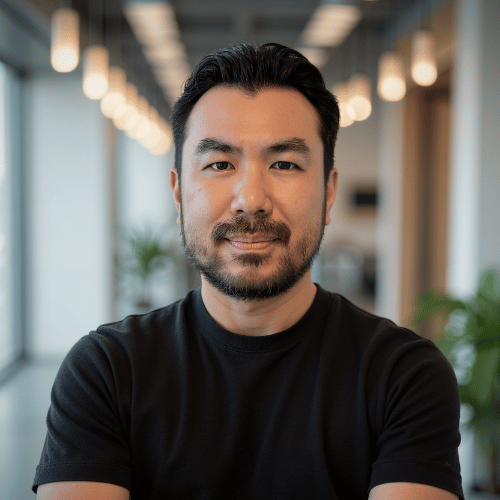
Jerald Lee
Commercial Systems Advisor
Jerald Lee is a Hong Kong-based Commercial Systems Advisor, founder of Curiosity At Work and Operating Partner of The Growth Coach Hong Kong. He spent 13 years at Google APAC and helps founder-led companies build predictable revenue systems.